
Explore how collective memory in Warhammer 40K turns belief into gods and ignorance into weaponry. Discover the dark physics of the Warp today.
Warhammer 40K sounds like someone played Mad Libs with every sci-fi and fantasy IP simultaneously while having a nervous breakdown. You’ve got Orks who shouldn’t be able to operate a doorknob building interstellar warships. Psychic space elves whose ancestors partied so hard they accidentally created a sex-torture god who now eats their souls. An empire of fascist humans who’ve been worshipping their comatose emperor for 10,000 years and he might have actually be a god because they wouldn’t shut up about it.
And somehow this works as a setting instead of collapsing under its own ridiculousness.
The glue holding this nightmare together is the Warp, an alternate dimension made of psychic energy where faster-than-light travel happens.
It responds to collective memory. What enough people believe becomes real. What entire species feel reshapes the dimension’s geography. Your cultural trauma builds monuments. Your species’ survival instincts feed entities that grow teeth.
Most settings would stop at “magic responds to belief” and call it a day. That’s already plenty of narrative juice to work with.
Games Workshop looked at that premise and asked what happens when you give the same metaphysical exploit to completely different species who all have legitimate reasons to want each other dead.
Every faction found a different way to break the same rule, and now they’re all stuck in a galaxy where reality belongs to whoever can convince the most people they’re right. Which would be fascinating if these people weren’t also trying to kill each other with consecrated chain swords and guns that shoot bees made of warp energy.
This is worldbuilding as arms race. Give everyone access to the same reality-warping mechanic, then watch them find increasingly unhinged applications while the galaxy burns.
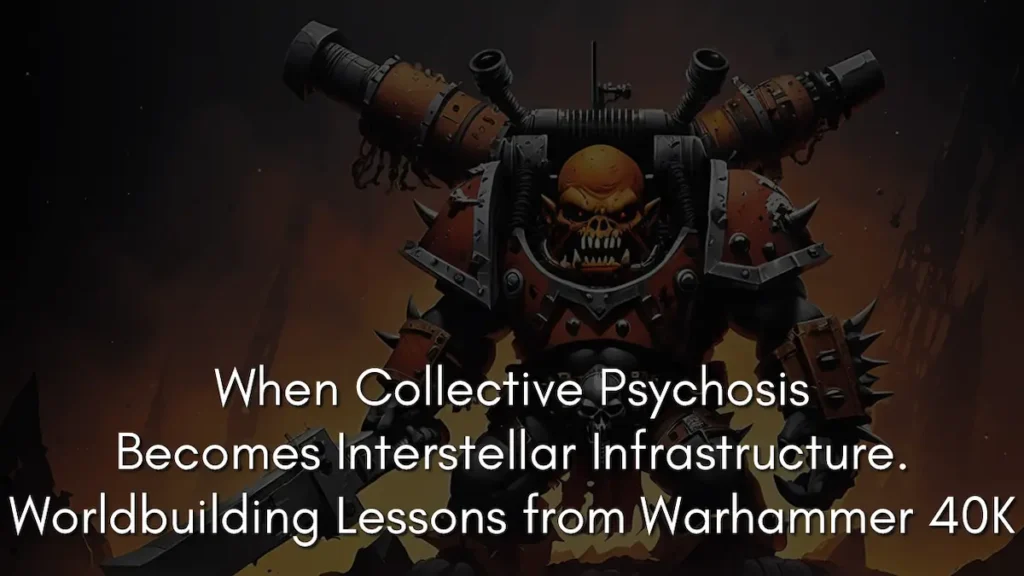
Table of Contents
- The Orks Turned Ignorance into a Competitive Advantage and Now Nobody Can Stop Them
- The Imperium Built an Atheist Empire and Accidentally Installed the God They Were Trying to Avoid
- The Chaos Gods Are What Happen When Your Feelings Are Weapons-Grade Fuel
- The Aeldari Threw a Rager that Birthed a Torture God
- The Tyranids Are a Galactic Mute Button Shaped Like Your Worst Nightmare
- Reality Doesn’t Care Who’s Right, Just Who’s Loudest
- Common Questions About Collective Memory in Warhammer 40K
The Orks Turned Ignorance into a Competitive Advantage and Now Nobody Can Stop Them
The Orks don’t do research and development. They don’t iterate on prototypes or peer-review each other’s schematics. They just build things that absolutely should not function, and those things function anyway because reality looked at a mob of green psychopaths and decided arguing wasn’t worth it.
An Ork slugga is missing its firing pin, has a barrel welded on backwards, and uses ammunition that’s technically gravel. The Ork pulls the trigger. The gun fires. It shouldn’t, but because three hundred Orks in the vicinity believe guns make things dead, their collective certainty bullies physics into compliance.
This is the Waaagh! field doing its job. A passive psychic field generated by Ork concentration that rewrites the pass/fail conditions for mechanical operation. It’s consensus reality operating as a species-wide exploit where the universe has to honor the outcome as long as enough greenskins agree on what that outcome should be.
What makes this truly unhinged is that the Old Ones, ancient psychic beings with a fondness for biological warfare, encoded their entire technological database directly into Ork DNA. The knowledge inherited. A Mekboy wakes up one day with an overwhelming urge to start welding scrap metal together, and six hours later he’s built a functional warp gate out of a car battery and vibes.
Technology unlocks at population thresholds like they’re leveling up in a video game, except the experience points are how many of their mates are standing nearby having a good brawl.
Which means Orks can field gravitational weapons that would take the Mechanicus three centuries and a mountain of corpses to develop, and they’ll do it using garbage they found, wire of unknown origin, and the absolute conviction that painting it red makes it shoot faster. And it does. The paint measurably increases projectile velocity because enough Orks think it should.
Ork advancement scales with population density, and Orks reproduce through spores. Not spores they plant intentionally. Spores they shed just by existing. Kill an Ork and congratulations, you’ve just fertilized the ground for the next generation. Every battlefield is a farm. Every victory is a delay.
You can’t out-tech them because they’re not limited by innovation cycles. You can’t educate them out of violence because war is in their DNA. The only solution is total extermination at a scale that requires sterilizing planetary systems, and even then you’ve probably missed a spore in a crater somewhere.
That spore becomes a fungus. The fungus becomes a squig. The squig gets eaten by a larger squig. That ecosystem eventually produces a snotling, then a grot, then a boy, and six months later you’re dealing with another Waaagh! because you thought “scorched earth” was a sufficient response to a species that treats extinction events as a mild setback.
Games Workshop made a species that can’t lose at technology and can’t stop reproducing and thought “yes, this will make a balanced faction.” And they were right, but only because they made everyone else in the galaxy also horrifically overpowered. The Orks are a permanent apocalypse that runs on fungal logistics and weaponized groupthink, and the only thing stopping them from drowning the galaxy in green is that they can’t stop fighting each other long enough to coordinate.
The Imperium Built an Atheist Empire and Accidentally Installed the God They Were Trying to Avoid
The Emperor of Mankind is simultaneously a desiccated corpse strapped to a golden life-support throne and a psychic entity of terrifying power manifesting across the galaxy to smite his enemies with holy fire. Which one he actually is depends entirely on whether the person you’re asking has access to the throne room or just a really good prayer routine.
He spent thirty millennia trying to starve Chaos Gods by convincing humanity that superstition was for idiots and rationalism was the only path forward. No gods. No spirits. No prayer. Just science, progress, and definitely don’t think too hard about the golden psychic superman who can kill you with his mind because that would undermine the whole “we’re being rational here” aesthetic.
Then Horus stabbed him, the Imperium panicked, and state-mandated atheism lasted exactly as long as it took terrified citizens to ask why their leader was a mummified husk who somehow still ran the empire. The answer they settled on was divinity. Much easier to accept than “our entire governmental structure is a Weekend at Bernie’s situation with a corpse.”
The Imperial Creed started as damage control and became metaphysical infrastructure. A quintillion human souls believing the Emperor protects with enough desperate fervor that the Warp looked at all that focused conviction and went “okay, sure, he’s a god.”
Nobody voted on this. Nobody engineered it intentionally. Humanity just collectively hallucinated their comatose leader into something resembling godhood because the alternative was admitting they’d been taking orders from a corpse for ten thousand years and that’s bad for morale.
Living Saints manifest on battlefields wreathed in golden fire, performing miracles that are obviously Warp-powered but get classified as divine intervention because the Ecclesiarchy has a branding department. The Legion of the Damned show up as burning space marines who aren’t technically alive anymore, murder everything hostile in a three-mile radius, then vanish like they were never there.
These are structured, repeatable events that only happen when someone prays hard enough to the man on the golden throne. If it walks like a Warp god and smites heretics like a Warp god, the Imperium has decided it’s definitely not a Warp god because that would mean the Emperor was wrong about the nature of divinity and we can’t have that.
A guardsman witnesses Saint Celestine resurrect mid-battle after taking a plasma blast to the chest. He survives, tells his squad, they tell their regiment, and suddenly ten thousand soldiers have proof that faith in the Emperor is a tactical asset. They pray harder. The Warp-Emperor gets stronger. More miracles manifest. More witnesses spread the word.
It’s a perpetual motion machine powered by desperate hope and the Imperium has no intention of turning it off.
The Ecclesiarchy figured out centuries ago that if belief shapes reality, proving the Emperor is divine is unnecessary. You just need people to act like he is. Perform the rituals. Recite the prayers. Execute the heretics who ask uncomfortable questions about metaphysics. The Warp handles the rest.
The Emperor banned religion to prevent humanity from creating the very thing he’s become. Trillions of people ignored him, worshipped anyway, and manifested a god through sheer force of collective delusion.
Whether the entity currently manifesting across the galaxy as divine wrath is the same person who conquered Terra during the Unification Wars doesn’t actually matter anymore. Consensus reality doesn’t care about your original identity. It cares about what a quintillion people think you are right now, and right now they think you’re a god.
The Imperium accidentally became the Aeldari on a faster timeline. The difference is the Aeldari’s belief-born god wants to torture them forever. Humanity’s belief-born god might actually be trying to help. Might. The jury’s still out and the jury has been dead for six thousand years.
The Chaos Gods Are What Happen When Your Feelings Are Weapons-Grade Fuel
The Chaos Gods are what happens when trillions of people feel scared or angry or ambitious at the same time for thousands of years and the Warp takes notes. You can’t kill them because they’re made of the emotions you’re currently feeling while reading this sentence.
They’re reflections in a funhouse mirror where the mirror gained sentience and decided it preferred the distorted version. Every worst impulse sentient life has ever had, pooling in a dimension made of thought until it achieved consciousness and started having opinions about things.
They can’t be killed because you’d have to eliminate the emotions that spawned them, and those emotions are structural to being alive. Anger keeps you from getting eaten. Ambition builds civilizations. Fear of death makes you look both ways before crossing the street.
The gods are eating the exhaust fumes of survival itself.
Khorne is every act of violence that ever kept someone alive long enough to reproduce, grown into something that doesn’t distinguish between murder and self-defense because blood is blood. He doesn’t care who wins the battle. Just that the battle happens and the body count climbs. Righteous fury and genocidal rage taste identical to a god made of weaponized anger.
Tzeentch is every hope for a better tomorrow, every scheme to fix what’s broken, every ambitious plan that someone genuinely believed would save everything. He’s the god of fixes, except today’s solution is tomorrow’s problem and he’s already three moves ahead of you. Progress is his favorite joke.
Nurgle is what happens when the fear of death ferments into acceptance. He offers the comfort of giving up to people too exhausted to keep fighting entropy. Your body is falling apart and Nurgle says “stop struggling, let it happen, aren’t you tired?”
He’s despair with a cheerful bedside manner, and his gifts are diseases that suspend you in the exact moment before death forever. You don’t get to die. You just get to rot while still conscious enough to appreciate the craftsmanship of your own decay.
Slaanesh is every attempt to feel something more intensely than your neurology was designed to handle. The Aeldari built her by treating sensation like a competitive sport, and now she’s everyone’s problem. Every boundary you push feeds her. Every time you want something badly enough to ignore the consequences, she gets a little stronger.
The very act of being alive feeds the things trying to kill you.
This isn’t a fight you can win through superior tactics or better technology. You can’t out-think a god made of thinking. You can’t out-fight a god made of fighting. The harder you struggle, the stronger they become, because struggle is exactly what they’re made of.
The Imperium looked at this problem and decided the only winning move is making sure nobody knows they’re playing. The Big Lie, the Inquisition, the summary execution of anyone who asks too many questions about what daemons actually are. It’s not tyranny for its own sake. It’s a quarantine protocol.
If knowing about Chaos makes you think about Chaos, and thinking about Chaos gives it power, then ignorance is the only defense that works. Information becomes a contagion. Knowledge is a pathogen. The Inquisition burn heretics because being right about daemons is more dangerous than being wrong.
The Imperium chose weaponized stupidity as a survival strategy, and in a universe where thoughts have teeth, they might actually be onto something.
The Aeldari Threw a Rager that Birthed a Torture God
The Aeldari used to run the galaxy. Post-scarcity civilization, functionally immortal, psychically powerful enough to reshape matter with a stray thought. They’d solved every problem worth solving. Frieren: Beyond Journey’s End, but in space.
So naturally they got bored.
When you’ve eliminated scarcity and death stops being a concern, the only remaining challenge is figuring out what you actually want. Turns out what the Aeldari wanted was more.
More pleasure. More pain. More novelty. They chased sensation like other species chase food, and they did it for thousands of years. An entire galactic empire pivoting toward increasingly unhinged hedonism because immortality makes you creative about boredom and they had a lot of time to workshop new ideas.
All that psychic energy had to go somewhere. Every indulgence, every boundary crossed, every experiment in what happens when you remove all ethical guardrails from a society with no material constraints. It condensed in the Warp like grease in a pipe, pooling into something coherent.
Something hungry.
The Aeldari were so busy exploring the limits of excess they didn’t notice they were sculpting those limits into a god.
Slaanesh didn’t arrive quietly.
The birth scream was a psychic detonation that ripped the heart out of the Aeldari empire and turned it into the Eye of Terror, a sucking wound in reality where physics is a suggestion and madness is the local weather. Billions of Aeldari died instantly, their souls vacuumed into the newborn god like it was hitting a buffet after a long fast.
The survivors got to watch their entire civilization collapse because they’d collectively fucked around for millennia and finally found out.
The survivors realized that Slaanesh now owns every Aeldari soul by default. Die and you don’t get peaceful dissolution into the cosmic background. You get dragged into the Warp for an eternity of torment tailored specifically to your personal idea of suffering.
The Craftworld Aeldari built the Path system as a workaround. Rigid emotional compartmentalization where you’re allowed to obsess over one thing at a time, master it completely, then seal it away and move to the next discipline. Be a warrior until you’re done being a warrior. Be an artist until you’re done being an artist. Never let yourself feel anything with enough sustained intensity that it creates ripples in the Warp.
It’s emotional accounting where every feeling has to be logged, categorized, and properly disposed of before you move on. You can be passionate about pottery, but only during pottery hours, and then you put it away before the passion ferments into something that attracts attention from the thing that wants to eat you. They’re basically Vulcans.
The Drukhari looked at the Path system and said absolutely not.
They fled into Commorragh, a city-sized tumor in the webway, and figured out that torturing other species produces psychic energy that keeps their souls topped off enough that Slaanesh can’t fully claim them. They built a subscription model for damnation where you pay in atrocities and hope you never miss a payment.
Cruelty became a metabolic requirement. They need to hurt people the way humans need to breathe.
Both solutions are survival protocols for a species that proved sin has a conversion rate. Enough Aeldari feeling the wrong things in the wrong way for long enough and you get a sentient predator wearing your species’ collective id as a skin suit.
The Aeldari turned their culture into a containment field because the alternative is an afterlife that makes the concept of hell look like a walk in the park.
The Tyranids Are a Galactic Mute Button Shaped Like Your Worst Nightmare
The Tyranids don’t counter psychic civilizations through superior sorcery or better-trained battle-psykers. They counter them by screaming so loud that nobody else’s thoughts can complete a full sentence.
Trillions of organisms sharing one brain generates a psychic signal that drowns out every other consciousness in the star system through sheer deafening volume. It’s the metaphysical equivalent of solving a debate by standing next to the microphone and shrieking until everyone else gives up and goes home.
The Shadow in the Warp hits a system like someone cut the fiber optic cables connecting your brain to your body. Astropaths reach for the Warp to send distress signals and find only static. Navigators try to chart a course by the Astronomican and discover the lighthouse has been replaced with a wall of screaming insects that extends to the horizon.
Psykers who attempt to draw power get the psychic equivalent of sticking a fork in an electrical socket, except the socket is billions of alien thoughts happening simultaneously and the fork is their frontal lobe. Most of them die before they finish the casting. The lucky ones just hemorrhage from the ears and spend the rest of their short lives drooling.
Non-psykers just die slower.
A Guardsman facing down a Tyranid swarm feels dread with no identifiable source. Despair that settles into his bones like he’s drowning in open air. The feeling that something vast and incomprehensibly hungry is looking directly at him, and he’s not a threat or even an obstacle. He’s a calorie count.
The psychic pressure makes him understand, in the part of his brain that still remembers what it was like to be prey on the African savanna, that fighting back is pointless and survival is a clerical error the universe will correct shortly.
Games Workshop needed a faction that could fight psychic demigods without having psychic demigods on the payroll. So they built a species that just turns off the magic and watches everyone else panic when their supernatural advantages stop working.
No Farseer visions. No sorcerous fireballs. No warp-powered miracles. Just you, your standard-issue lasgun, and the sudden horrifying realization that you’re fighting a meat tsunami with no supernatural backup plan.
The mechanism is almost elegant in its brutality. Tyranid organisms don’t have individual souls because they’re all fingers on the same hand. The Hive Mind exists partially in the Warp as a singular, stable thought that’s too structurally coherent to be drowned out by anything smaller than itself.
Chaos Gods are turbulent reflections of a billion conflicting emotions. The Hive Mind is one emotion at galactic scale. Hungry. Singular. Utterly uninterested in your feelings about the situation.
Where Chaos churns and shifts based on what mortals believe about it, the Hive Mind just is, immutable and vast, and it will still be here after your entire species has been converted into biomass and processed into the next wave of invasion.
Every other faction in the galaxy has spent millennia developing psychic trump cards, and the Tyranids counter all of them by making the Warp temporarily unavailable for use.
What’s left is material reality in its most stripped-down, merciless form. Ammunition versus biomass. How many rounds you brought versus how many bodies they can afford to throw at your position until you run out.
The Tyranids win by having more. More organisms. More reserves. More reinforcements currently being vat-grown in the bellies of bio-ships that are themselves alive and hungry and already eating the planet’s atmosphere while you’re still trying to establish a perimeter.
Reality Doesn’t Care Who’s Right, Just Who’s Loudest
Games Workshop looked at the standard fantasy trope of “belief shapes reality” and asked what happens when you give that power to five different species who all have legitimate grievances and access to weaponized war crimes.
The Warp doesn’t discriminate. It just converts. Belief goes in, and whatever comes out is now everyone else’s problem.
The Orks turn junk into functional war machines through mob consensus. The Imperium accidentally deified a corpse by praying at it for ten millennia. The Aeldari locked themselves in emotional solitary confinement to avoid feeding the sex-torture god they spawned. The Tyranids weaponized tinnitus at a galactic scale. And Chaos just sits back and harvests the emotional runoff from everyone else’s survival attempts.
Same metaphysical exploit. Five completely different applications.
Nobody gets a handicap for being the good guys because there aren’t any good guys.
There’s no rock-paper-scissors logic where Orks beat Tyranids who beat Chaos who beat the Imperium in some satisfying flowchart you could teach to a Pokémon player. The Warp doesn’t produce clean counters. It produces different flavors of catastrophic advantage that work until they don’t.
Everyone’s winning and losing simultaneously depending on which Tuesday you’re asking about and which sector of the galaxy just got eaten.
Most settings treat “belief shapes reality” as a narrative flourish. A fun quirk that gets mentioned in the lore and maybe shows up during a boss fight.
Warhammer 40K made it the foundational constraint. Every faction’s economic model, military doctrine, and long-term survival strategy ripples from manipulating what billions of people think is true, and doing it better than the five other species trying to manipulate the same dimensional infrastructure in completely incompatible directions.
Games Workshop built a setting where your thoughts can kill you, your enemies’ thoughts can kill you, and your allies’ thoughts can also kill you.
The galaxy runs on collective psychosis held together by weaponized ignorance, and the only thing preventing total collapse is that everyone’s too busy trying to exterminate each other to coordinate on making things worse faster.
It’s elegant. It’s horrifying. It’s the only reason the setting’s perpetual apocalypse doesn’t resolve itself.
[Read more in our deep dive on the ripple effects of collective memory as a worldbuilding constraint.]
Common Questions About Collective Memory in Warhammer 40K
How does collective memory in Warhammer 40K create the Chaos Gods?
The Warp is a psychic dimension that reflects the collective emotions and subconscious of all sentient life. When specific concepts like war, decay, change, or excess are felt with enough sustained intensity by trillions of beings over millennia, that collective memory in Warhammer 40K condenses into a sentient, hungry entity known as a Chaos God. These entities are the distorted reflections of survival instincts like anger for protection or ambition for progress that have been warped into monstrous caricatures by the sheer volume of psychic energy. They function much like the New Gods in American Gods, where the act of collective attention provides the energy for a concept to achieve sentience, but in the grim darkness of the far future, that attention is fueled by the desperate exhaust fumes of survival itself.
Why can Orks ignore the laws of physics using collective memory in Warhammer 40K?
Orks possess a unique biological quirk called the Waaagh! field, which functions as a localized, species-wide form of collective memory in Warhammer 40K. Their absolute, unified certainty that “red ones go faster” or that a non-functional pile of scrap is a deadly gun essentially bullies the laws of physics into compliance. This consensus reality operates as a psychological exploit where the universe honors the Ork’s intended outcome as long as enough greenskins believe it should work.
Is the Emperor of Mankind a god because of collective memory in Warhammer 40K?
The Imperial Creed forces a quintillion humans to worship the Emperor with desperate fervor, creating a massive, focused psychic footprint within the Warp. This sustained collective memory in Warhammer 40K has manifested repeatable miracles, living saints, and the Legion of the Damned, effectively deifying the Emperor regardless of his original atheist intentions. Whether the entity in the Warp is the same man who sat on the throne ten thousand years ago no longer matters. Consensus reality defines him as a god now.
How do the Tyranids suppress collective memory in Warhammer 40K?
The Tyranids utilize the Shadow in the Warp, which is a massive psychic signal generated by trillions of organisms sharing a single Hive Mind. This signal acts as a galactic mute button that drowns out all other forms of collective memory in Warhammer 40K through sheer deafening volume. It effectively severs the connection between belief and reality for other species, making it impossible to send distress signals or manifest miracles while the Hive Fleet is present.
What happens to the Aeldari because of their legacy of collective memory in Warhammer 40K?
The Aeldari are a cautionary tale of what happens when a psychically powerful species focuses its collective memory in Warhammer 40K on unchecked excess and hedonism. Their thousands of years of indulgence condensed into the birth of Slaanesh, a god that now owns every Aeldari soul by default. To survive, they must now use rigid emotional compartmentalization or constant cruelty to keep their own collective psyche from being consumed by the very entity they accidentally created.
–
Jay Angeline is a science fiction and fantasy writer with a background in physics and over twenty years of analytical work. Through short fiction and worldbuilding articles, Jay explores the mechanics that make imaginary worlds feel real, using a thoughtful lens and a touch of humor.