
Discover why the famous curse was actually a performance review. The sentient objects in Beauty and the Beast represent the darkest parts of workplace burnout, and their return to humanity might be the most tragic ending of all.
Gabrielle-Suzanne Barbot de Villeneuve published the original La Belle et la Bête novel in 1740, where the Beast’s enchanted castle was staffed by monkeys performing three-act plays, parrots delivering all the dialogue from the rafters, and invisible hands opened doors.
Jean Cocteau’s 1946 film escalated into full surrealism, with human arms growing from stone walls to hold candelabras, marble statues tracking Belle’s movements across rooms with their eyes. Unsettling, but still just the Beast’s psychological interior rendered in production design.
Neither of them invented Lumiere, a flaming maître d’ who spends his days seducing a feather duster.
Disney wanted a musical. Howard Ashman and Alan Menken were writing Broadway structure into animation, which meant backup singers, comic relief, and someone to carry “Be Our Guest” while their furry lead was upstairs brooding. So they grabbed Cocteau’s living architecture, welded it to the practical demands of ensemble musical theater, and invented the cursed servants as sentient objects that children around the world know and love.
All the named servants, and the dog, got cursed into household objects by an angry enchantress. The curse saw what each person had quietly reduced themselves to through decades of service, located the household object that best captured that self-reduction, and turned the job description into the body.
You oriented your entire identity around punctuality? Time is your skeleton now.
You burned with romantic ambiance? Now you’re on fire.
You dispensed maternal comfort so reliably that people stopped seeing you as a person with needs and started treating you as an emotional vending machine? You’re a teapot, and pouring yourself out is no longer a personality trait. It’s what your body does when someone tips you forward.
The curse is equal parts punishment for enabling a cruel master and erasing yourself in service to that master, and it uses your job history as the blueprint.
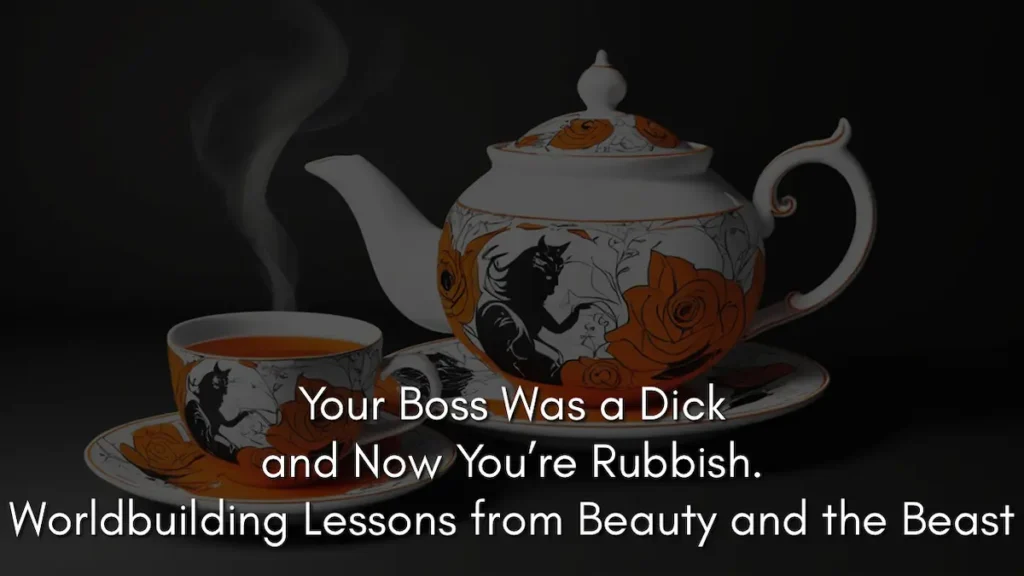
Table of Contents
- The Curse Didn’t Transform Anyone. It Ran Performance Reviews.
- Your New Body Can Still Experience Pain
- Two Ways the Deadline Ends, Neither of Which Is Kind
- The Door Was Open and They Went Straight Back to Work
- Common Questions About Sentient Objects in Beauty and the Beast
The Curse Didn’t Transform Anyone. It Ran Performance Reviews.
Lumiere worked as maître d’. His job description was essentially “create atmosphere and make everyone comfortable,” so he becomes a candelabra.
Every social interaction for the next decade happens while he’s actively combusting, which tracks, because he’d been burning himself out so everyone else had good lighting since before the curse arrived. The enchantress found a man who had already made himself into a party lamp through sheer professional commitment and formalized the arrangement.
Cogsworth managed the prince’s schedule with the obsessive precision usually reserved for air traffic controllers and people who laminate their personal calendars. Punctuality was his entire moral philosophy, the framework through which he evaluated other human beings and found them wanting on a sliding scale of lateness.
He becomes a mantle clock. His body ticks. Every second that passes announces itself audibly inside his torso where his organs used to be. Time became his circulatory system.
Mrs. Potts ran the castle as head housekeeper, distributing tea and maternal wisdom to anyone within a five-mile radius, solicited or not. So naturally she becomes a teapot so she can spill the tea.
Her previous career had been pouring herself into other people’s problems. The enchantress just changed the mechanism from figurative to anatomical. She pours from her nose (in the animated version) so people can drink liquid stored inside her hollow ceramic body.
Madame de la Grande Bouche (or Madame de Garderobe) performed as the castle’s opera singer. Her stage name means “Madame Big Mouth,” which doubles as both job title and personality inventory. She’s all voice and volume and theatrical presence that filled every room she entered before anyone could stop her. (Lore note: in the original animated she was an unnamed lady-in-waiting.)
She becomes an enormous and ornate and aggressively decorated wardrobe, with doors that swing open like a mouth mid-aria. The enchantress looked at a woman whose entire existence was “theatrically loud” and gave her a body that can only enter a room by flinging both doors open simultaneously after finding the most dramatic lighting around.
Chef Bouche ruled the kitchen with hot-tempered authority that makes Gordon Ramsay look like a grief counselor. The enchantress turned him into a stove. This one barely required paperwork.
The enchantress didn’t punish these people by forcing them to become something alien. She punished them by making literal what they had already chosen to be, and then adding weight limits and a note that they’ll chip if dropped.
Animal transformation is the genre standard. The Beast himself wanders freely, travels to rescue people, maintains complete agency while looking like what happens when a buffalo develops a gothic interior design sensibility. Animal curses come with the ability to stomp away.
If you’re the one person who hasn’t seen Beauty and the Beast, you might expect that turning the servants into the furniture Prince Adam had always viewed them as, rather than the conventional animals, would mean them not being able to move. You’d be wrong.
Lumiere hops across multiple rooms arguing with Cogsworth. Mrs. Potts rolls her base across marble floors. Plumette, the feather duster, flies, since the curse apparently came with magical abilities for some. (In the original animated version, Plumette was Fifi and she glides rather than flies.)
Nobody is anchored in place. The loss isn’t physical freedom. The loss is that your body is now a candelabra, and candelabras have a sharply limited set of possible actions regardless of what you’d personally prefer to do with your afternoon. Kind of hard to be with a feather duster when you’re about to set her on fire.
Your New Body Can Still Experience Pain
Lumiere lights and extinguishes his flames casually with no appearance of pain. In The Enchanted Christmas, he melts ice using his body heat like it’s a resting metabolic function, like active combustion is just his baseline physiological state.
But during the climactic battle with the villagers in the animated version, LeFou threatens him with a torch and Lumiere reacts with visible fear. His own fire doesn’t register as injury, but it’s evident that external fire can kill him. LeFou also pulls feathers from Fifi the feather duster and she makes sounds of distress.
In the 2017 live-action version, Maestro Cadenza exists as a harpsichord whose keyboard keys are his teeth. When certain notes get played, he flinches from cavities. He then later weaponizes the keys during the battle by shooting them at attackers, which is simultaneously the bravest and most medically disturbing thing anyone does in this film. When the curse breaks and he’s human again, he’s missing teeth in the exact positions where keys were used as bullets in the fight.
Similarly, Chip the teacup has a chip in his rim. When he becomes a human boy, he has a missing tooth in the identical location. Hopefully that was just a baby tooth.
The soul and the object share one blueprint. Break the cup, break the kid. Workplace injuries accrue against your permanent physical record, with no workers’ compensation, no appeals process, no union representation.
This also means you can die as an object. Maestro Forte, the pipe organ from The Enchanted Christmas, dies when the Beast tears him from the wall and smashes him. A pipe organ with destroyed pipes and no working keyboard is wreckage, not an instrument. In contrast, Chip survives because a chipped cup still functions as a cup, purpose intact.
“Human Again,” cut from the 1991 theatrical release and restored in 2002, catalogs their losses with uncomfortable precision. They want to wear clothes again. To cook for pleasure. To experience physical touch. Their object forms deny them textures and sensations they can still remember perfectly.
The Enchanted Christmas shows the servants struggling with severe depression around the curse’s anniversary, maintaining mandatory cheerfulness to avoid triggering the Beast. Walking on eggshells around an unstable authority figure while performing compulsory happiness is textbook trauma response behavior.
The 2017 film finally offered an explanation for why the servants were cursed alongside the prince, rather than just being at the wrong place at the wrong time. Just before “Days in the Sun,” Mrs. Potts explicitly acknowledge their culpability. They watched the prince’s father psychologically destroy his son after the mother’s death, saw a child getting shaped into a monster through grief and institutionalized cruelty, and said nothing, because moral intervention would have been professionally inconvenient.
The curse has nothing to do with serving a cruel master. The enchantress punishes them for treating “watching a child get psychologically dismantled” as someone else’s department, which is a different crime entirely and one they’ve had no trouble repeating ever since.
Their response to acknowledging this is to keep serving. After all, “Be Our Guest” shows us that “Life is so unnerving for a servant who’s not serving, he’s not whole without a soul to wait upon.” This may sound like cheerful hospitality, but it’s really a confession delivered with a tune and a smile.
Two Ways the Deadline Ends, Neither of Which Is Kind
The last petal falls in the 2017 version before Belle can say the words, and the servants die on camera. Their painted faces go blank. Movement stops entirely. They become the kind of antique you’d find at an estate sale without realizing you’d just purchased someone’s final conscious moment.
Then when they get the happily ever after, either the enchantress resurrected the servants, meaning she has dominion over death itself and has been sitting on this the entire time, or they remained conscious inside motionless objects, trapped in total sensory darkness with no way to measure how much time had passed. Waiting for rescue or destruction with no ability to indicate a preference. The film doesn’t clarify. The enchantress knows which one it was and she’s not saying. Both fates are horrifying for a children’s movie.
The 1991 film doesn’t go that direction. There the curse is simply permanent, “doomed to remain a beast for all time” per the narration, and the servants share this outcome. Eternal consciousness inside object form. No aging, no death, no sleep. Just infinite awareness as kitchenware, serving a master who has definitively failed, in a castle that will never change, for the full length of infinity.
Not a death sentence. A life sentence with no parole board, no good behavior credit, no appeal process. Just you and your function and the concept of forever, very quietly, inside a teapot.
Maestro Forte, the pipe organ from The Enchanted Christmas, wants the permanent version deliberately.
As a human court composer he was gloomy, unwanted. As a cursed pipe organ fused to the castle’s walls, he channels magic through the entire building. His music shatters windows, manipulates emotions, warps physical reality across multiple floors.
He went from disposable background musician to the building’s nervous system, functionally immortal now, and he is not interested in a severance package that resets him to forgettable. He explicitly states that humanity is overrated and actively sabotages Belle’s romance with the Beast.
The curse was the best career move he ever made. Restoration would be a demotion back to mediocre, with worse benefits and no magic and no reason for anyone to remember his name. But he gets ripped from a wall and smashed, so enough about him.
Regardless of the version, the curse breaks and everyone gets their Disney happy ending. Human bodies return. Human voices, faces, full autonomous motion in every direction. The Beast becomes Prince Adam again, much to Belle’s disappointment.
The door is open. The servants can leave. They can demand back wages for ten years of labor performed under conditions that would violate every workplace safety regulation ever written. They can walk to the village and spend the rest of their lives refusing to pour anyone anything ever again.
Instead, they go back to work.
Not because magic compels them. During the curse they defied the Beast’s direct orders repeatedly, hid Maurice, threw Belle a dinner party he specifically forbade. Free will was never the problem.
The problem is that service was the only identity any of them ever developed, and restoration changed the material of the prison without addressing any of the architecture that made them vulnerable to it. The enchantress was right about all of them. The servants spent ten years as evidence in the case she made against them, and the verdict came in when the curse broke and they walked straight back to the kitchen.
The Door Was Open and They Went Straight Back to Work
Mrs. Potts got her body back, looked at her human hands for a moment, and went to put the kettle on. The servants all went back to their stations.
The Beast was upstairs having a love story. The enchantress was already gone. There was no contract, no reissued employment paperwork, no summons to the throne room. They resumed the roles they’d held before the curse because those roles were their identities, and getting your body back doesn’t change that.
Villeneuve gave us invisible servants. Cocteau gave us disembodied human limbs emerging from the walls. Disney gave us people who loved their jobs so completely that they became their jobs, suffered inside those jobs for a decade, got rescued from those jobs, and went straight back to those jobs because they had no remaining concept of themselves that wasn’t the function. American capitalism at it’s finest.
The Beast got a redemption arc. The servants got a diagnosis. The diagnosis proved accurate.
The enchantress didn’t punish them for serving a cruel prince. She punished them for having no self beyond the service, for watching a child get psychologically destroyed and deciding that was above their pay grade, for building identities so completely out of function that function was all that remained. She didn’t give them anything they hadn’t already made themselves into. She just made it structural so they’d have to look at it directly for ten years and reckon with what they’d done to themselves.
They reckoned with it. They went back to work.
The door was open and they chose to continue their lives as furniture.
[Read more about sentient objects across fantasy in our deep dive.]
Common Questions About Sentient Objects in Beauty and the Beast
Why were the servants turned into household objects instead of animals?
The choice to transform the staff into household objects rather than animals serves a specific narrative and psychological purpose. While the Beast’s animalistic form represents his loss of humanity and descent into primal rage, the servants’ object forms represent their loss of identity. By turning them into the tools of their trade, the curse makes their professional utility their entire physical reality. It suggests that they had already reduced themselves to their job descriptions long before the magic took hold, effectively turning their resumes into their anatomy.
Why were the servants transformed into specific items like a clock or teapot?
The curse did not choose these forms at random or simply to be cruel. Instead, it acted as a reflection of how each servant had already dehumanized themselves through their work. The enchantment identified the specific job function that the person had allowed to consume their identity and turned that job description into their physical body. Cogsworth became a clock because he obsessed over time, while Lumiere became a candelabra because he burned passionately to create a warm atmosphere for others.
Did the sentient objects in Beauty and the Beast feel physical pain?
Evidence across the various film versions suggests that the objects maintain a biological connection to their new forms. In the animated classic, characters show fear toward external threats like fire or being plucked, and in the live-action adaptation, the harpsichord flinches when his keys, which are also his teeth, hit a cavity. These injuries often carry over into their human forms after the curse is lifted, proving that the transformation was not a shell but a fundamental restructuring of their living bodies.
Why is Maestro Forte different from the other cursed servants?
Maestro Forte serves as a unique foil to the other servants because he views the curse as a promotion rather than a punishment. As a human, he felt unappreciated and small, but as a sentient pipe organ fused to the castle walls, he became the literal voice and power of the architecture. His refusal to seek a cure highlights a dark truth about the curse. That for someone who has entirely abandoned their humanity in favor of power or function, the object form is a perfect, immortal upgrade.
What was the moral reason for cursing the innocent staff members?
The animated classic provides no explanation. They’re collateral damage. The 2017 film clarifies that the servants were not innocent bystanders but were instead complicit in Prince Adam’s development. By standing by and watching his father mistreat him without intervening, they prioritized their professional safety over the moral well-being of a child. The Enchantress punishes them for this specific passivity, forcing them to inhabit the roles of the furniture they acted like when they chose to stay silent and just do their jobs.
Do the servants stay changed forever if the rose petals all fall?
The stakes of the deadline vary by version, but the outcome is consistently grim. In the live-action remake, the expiration of the deadline causes the sentient objects to become inanimate antiques, effectively a death sentence. In the original animated version, the curse simply becomes permanent, meaning the servants would be trapped in their object forms for eternity with no hope of aging, sleeping, or dying, forced to perform their functions forever in a frozen castle.
What happens to the servants after they become human again?
The most unsettling part of the story is that the servants immediately return to their previous roles once the curse is broken. Despite spending ten years trapped as furniture, they do not leave the castle or seek new lives. Because they had built their entire identities around service before the curse, they have no concept of self outside of their labor. They regain their human bodies only to voluntarily place themselves back into the same servitude that defined their punishment.
–
Jay Angeline is a science fiction and fantasy writer with a background in physics and over twenty years of analytical work. Through short fiction and worldbuilding articles, Jay explores the mechanics that make imaginary worlds feel real, using a thoughtful lens and a touch of humor.