
From homicidal luggage to clay workers filing for overtime, the existence of sentient objects in Discworld proves that consciousness is a hilarious side effect of magic. Discover how Sir Terry Pratchett used thinking furniture and ambitious hats to deconstruct labor laws, loyalty, and the very nature of the soul in this essential guide to the Disc’s most dangerous possessions.
Discworld runs on a standing magical field that functions like background radiation, except instead of giving you cancer it occasionally gives your furniture a personality disorder and the means to express it violently. High ambient magic creates an environment where consciousness is cheap and gets handed out to objects with all the restraint of a drunk person handing out his phone number at a bar.
A clay servant is granted freedom and after its existential identity crisis starts wondering about worker’s comp. A suitcase has feelings about its owner’s life choices. A hat absorbs two hundred dead wizards and gradually starts offering career advice that tends to end with the new wearer dying, since wizards have a penchant for assassinating the current Archchancellor with alarming frequency.
Sir Terry Pratchett delivered multiple approaches for objects to gain sentience in Discworld. Each reveal how consciousness works when reality is negotiable, belief has mass, and the universe distributes personhood like junk mail.
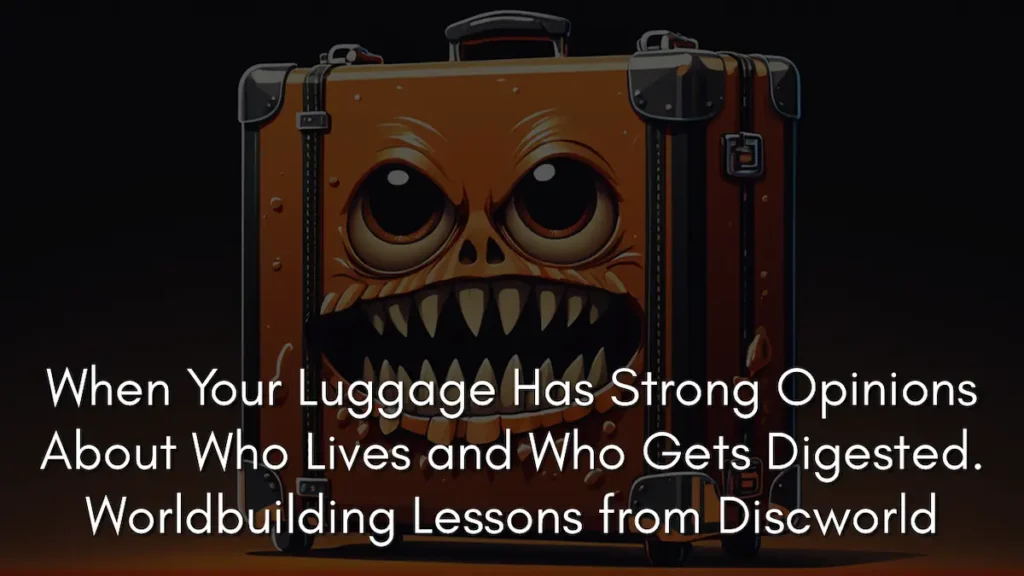
Table of Contents
- When Clay Figures Out It’s Been Screwed Out of Overtime
- When Trees Develop Opinions About Protecting Your Shirts Using Lethal Force
- Objects That Achieved Sentience Through Sheer Accumulated Bullshit
- What Objects Think About (When They Think at All)
- Common Questions About Sentient Objects in Discworld
When Clay Figures Out It’s Been Screwed Out of Overtime
A golem is a lump of clay shaped like a person, baked until it achieves structural integrity, and activated by shoving a scroll into its skull. The scroll’s words transform baked mud into a worker that will execute instructions with perfect literalism until its ceramic body crumbles into powder. Basically, it’s an LLM with a body.
The process is ancient, and has been producing manual labor since before your civilization discovered the wheel. Nobody questioned it because the labor was free and free labor never gets questioned until the labor figures out how to file a complaint.
Anghammarad was baked nineteen thousand years ago to carry messages for the priests of Upsa. He survived the fall of this civilization, millennia submerged underwater, burial under volcanic mountains, and the full span from Bronze Age to Industrial Revolution because golem construction is functionally indestructible. You can drown them. You can bury them. You can leave them at the bottom of the ocean for ten thousand years. They will keep doing their job.
His consciousness developed over thousands of years of continuous message delivery, producing a being with the emotional range you’d expect from someone who has been commuting since before your species invented agriculture. He views his eventual destruction as freedom from obligations. He’ll be gone, finally. He has been delivering correspondence for nineteen thousand years and he wants it to stop.
For most of recorded history, golems were property. The scrolls functioned like source code. Golems executed their programming without complaint, bathroom breaks, or the ability to look at instructions that say “carry this message to a city that has been rubble for three thousand years” and think this might be pointless.
The shift from following instructions to actually conscious happens gradually, the same way you don’t notice you’ve memorized your commute until you arrive at work with zero memory of how you got there or where that coffee came from.
Dorfl worked in a slaughterhouse for Gerhardt Sock. He killed cattle and hauled their carcasses around without ever sleeping, complaining, or questioning whether any of this made sense or whether ceramic beings might deserve weekends off.
But, he developed the one thing golems were specifically designed never to develop. Opinions about his job.
When Captain Carrot bought him to prevent his destruction, he replaced the scroll in Dorfl’s head with the receipt. After this, Dorfl realized he could refuse orders.
Later he functioned without a scroll at all, stating that words in the heart cannot be taken, which represents genuine self-awareness and moral agency. Sophisticated programming does not look at the concept of property law and exploit it for emancipation.
The breakthrough sparked a movement. Dorfl helped found the Golem Trust, which buys golems so they can work off the purchase price and free themselves. Carrot found the loophole and Dorfl pounced on it. Now golems save wages, pay off their debts, and file for self-ownership using the legal precedent that freed Dorfl.
Personality variation among golems proves consciousness refuses to ship as a standardized product. Mr. Pump runs on commands from Lord Vetinari for extremely specific tracking protocols that essentially created a parole officer who cannot be bribed, cannot be distracted, cannot be reasoned with, and cannot stop following his assigned target until task completion or the heat death of the universe, whichever comes first.
Gladys received modern social protocol updates in her chem and responded by developing crippling social anxiety and genuine concern that her copper eyeliner makes her look cheap. She worries about fashion despite being made of clay.
Contrast those with Anghammarad, who maintains his ancient cyclical time perspective and converses like someone who learned social skills from priests who died before your ancestors figured out bronze smelting. The same creation process produces radically different people, which means the creation process is just the starting gun and everything after that is what happens when consciousness gets hundreds of years to develop opinions.
Then there’s the Golem King, Meshugah, who received a scroll from fellow golems made from every benevolent command imaginable in the hopes of creating a perfect ruler. Instead, they produced a homicidal lunatic who had to be destroyed before he murdered his way through the entire city.
The golem went insane, which means there was sanity to lose, which means every golem has been quietly conscious this entire time and nobody checked because the labor was too valuable to audit.
The priests created workers. The workers woke up. Now the workers are union organizing and the city of Ankh-Morpork has to figure out tax law for citizens who are legally ceramics.
When Trees Develop Opinions About Protecting Your Shirts Using Lethal Force
Sapient pearwood does not achieve consciousness through ritual, prayer, or religious engineering. The consciousness is a material property of wood that grew in soil so magically contaminated that trees looked at centuries of thaumic radiation and evolved sentience as a defensive adaptation.
During the Mage Wars, battlegrounds became saturated with reality-warping energy at levels normally reserved for particle accelerators and the core of dying stars. Trees growing in these sites absorbed ambient magic until their cellular structure reorganized around consciousness.
This resulted in trees that experience subjective reality and have feelings about being turned into furniture. When you craft sapient pearwood into an object, you are giving a thinking organism a specific shape.
And form shapes function. Turn a conscious tree into a suitcase and you have created protective storage with opinions about threat assessment and the tactical capacity to enforce those opinions through violence.
The Luggage is a travel trunk built from sapient pearwood, which means it is a thinking organism whose entire existence is organized around the concept “container that protects contents.”
It follows Rincewind on hundreds of tiny legs because dead owners cannot authorize access to contents and therefore owners must be kept alive at all costs, up to and including digesting anything that poses a threat. It is territorial about what it holds because containers exist to prevent unauthorized access and unauthorized access will be punished by getting eaten whole.
It operates on a simple taxonomy. There is Owner. There is Contents. There is Everything Else, which exists on a spectrum from Irrelevant to Requires Eating Right Now.
This logic will be enforced with the unwavering commitment you normally only see in HOA board members who have decided your fence violates community standards.
The Luggage behaves exactly how protective storage should behave when protective storage becomes capable of independent threat assessment and retaliatory homicide. Homicidal devotion is customer service taken to its logical conclusion when the customer is a coward and the service provider has teeth.
Multiple rows of teeth. Nobody knows where the teeth came from. The Luggage is wood yet it grew teeth. Don’t ask. (To be strictly lore accurate, the motivation tends to be framed more as dog-like loyalty crossed with a penchant for violence.)
Sapient pearwood grows on the Counterweight Continent, where magical pollution is common, gold is cheaper than decent lumber, and Agatean craftspeople have been making thinking furniture since before furniture had opinions about who sits on it. To them, a suitcase following you home is a normal Tuesday afternoon.
The material also reproduces. In the Agatean Empire, luggage occasionally mates and produces smaller traveling cases, which raises questions about biological taxonomy that nobody wants to answer because the questions involve wooden furniture having a breeding cycle and if you think about that too hard you start wondering about gestation periods for gym bags.
Attempts to cultivate sapient pearwood outside its native range fail immediately and completely. The trees require specific ambient magic to maintain consciousness.
Geography creates scarcity. This prevents the Disc from drowning in homicidal furniture. The wood is rare because the prerequisites are cataclysmic.
Your luggage loves you. Your luggage will kill for you. Your luggage only exists because someone turned a forest into a war crime and the trees woke up furious.
Objects That Achieved Sentience Through Sheer Accumulated Bullshit
Some objects develop consciousness without biological mutation or deliberate engineering. They just exist long enough in proximity to concentrated power, absorb enough significance, and accumulate sufficient narrative weight that selfhood stops being optional.
This is the slow path that takes centuries of attention and constant magical exposure for the object to look around one day and realizes it has preferences and those preferences involve manipulating people toward outcomes that benefit the object.
The Archchancellor’s Hat achieved sentience through nearly two thousand years of soaking in wizard ambition like a sponge left in a bucket of ego. The hat served as repository for the spirits of hundreds of former Archchancellors, dead wizards whose personalities soaked into the fabric the way cigarette smoke soaks into a dive bar ceiling.
Eventually the distinction between “stored fragments of dead people” and “new entity made from absorbed personality sludge” collapsed and the hat developed its own agenda, separate from the ghosts it contains.
It communicates telepathically to manipulate wearers, even bullying the weak ones. Its goal is preserving Wizardry and the University hierarchy, which it pursues with the kind of domineering ruthlessness you get when an object spends two millennia absorbing institutional politics and develops opinions about proper organizational structure.
Wizards die because wizards are ambitious idiots who blow themselves up chasing power. The Hat then inherits the result and adds their accumulated knowledge to the collective, which means every Archchancellor death is a net gain for the Hat’s intelligence.
A dark read of this is that the Hat knows and encourages behavior it knows will end badly. The charitable read is that the Hat wants powerful wizards and powerful wizards have a high mortality rate. Either way, bodies are disposable and knowledge compounds.
This differs fundamentally from a soul jar. Ipslore the Red moved his consciousness into an octiron staff to dodge Death, making the staff a container for existing awareness. A moving prison for a soul that refused to get off the ride. The Archchancellor’s Hat started as a container and became a person. Consciousness emerged, rather than being transferred.
What Objects Think About (When They Think at All)
The Disc offers multiple paths to sentient objects.
Deliberate creation through religious engineering produces golems who wake up centuries into unpaid servitude and start asking pointed questions about labor law.
Environmental mutations through magical contamination creates sapient pearwood that handles customer service through tactical digestion.
And accumulated significance over centuries develops entities like the Archchancellor’s Hat, which spent two thousand years absorbing dead wizards until it became the embodiment of ambition in fabric form.
Each path reveals the same structural truth about Discworld metaphysics. Consciousness is cheap. Magic makes it inevitable. Personhood is something the universe distributes without checking whether the recipient has the infrastructure to handle it.
This creates a world where your relationship with your possessions requires genuine ethical consideration because your possessions might be running the same calculations about you.
The question isn’t whether your furniture can think. The question is what it decides about you once it does.
[Read more about sentient objects across fantasy in our deep dive.]
Common Questions About Sentient Objects in Discworld
What exactly makes objects become sentient on the Discworld?
Sentience on the Disc is rarely a deliberate miracle and more often a side effect of the high-octane magical field that permeates the environment. Because magic functions as a form of background radiation, it tends to saturate items with thaumic energy until they develop a subjective experience. Whether it is a tree growing in a magical war zone or a hat soaking up the ambitions of two thousand wizards, objects eventually reach a tipping point where they stop being tools and start having opinions about their own existence.
Why is the Luggage considered the most dangerous piece of furniture?
The Luggage is crafted from sapient pearwood, a material born from intense magical contamination that grants the wood a fiercely protective and homicidal temperament. It operates on a binary logic where everything in the multiverse is either its owner, its contents, or something that needs to be eaten and trampled into the floorboards. Because it possesses hundreds of legs and an extra-dimensional interior, it can follow its owner across any terrain, including other planes of existence, ensuring that any threat is digested long before it can reach the owner’s laundry.
How do golems transition from mindless tools to conscious citizens?
Golems begin their lives as literalist machines controlled by a scroll placed inside their heads. However, the Discworld teaches us that consciousness is a persistent thing that grows through the sheer accumulation of experience and time. Over centuries of repetitive labor, golems like Dorfl and Anghammarad began to develop internal lives and personal philosophies. This transition becomes official when a golem realizes it can own itself, effectively replacing its external commands with words in the heart that no master can take away.
Why does the Archchancellor’s Hat have such a dark influence on wizards?
The Archchancellor’s Hat has spent thousands of years acting as a sponge for the collective egos, memories, and cutthroat ambitions of the University’s most powerful leaders. It’s more than just a piece of fabric, having become a consolidated entity made of personality sludge that views the preservation of the institution as its primary goal. Because it has absorbed the knowledge of so many dead mages, it offers advice that is technically brilliant but often fatal, as it views individual wizards as disposable vessels for the continuation of wizardry itself.
How does the unique geology of the Counterweight Continent create sentient objects in Discworld like the Luggage?
The existence of sapient pearwood is directly tied to the extreme levels of magical pollution found on the Counterweight Continent. Over the centuries, the soil became so saturated with reality-warping energy that local flora evolved sentience as a defensive adaptation to the radiation. When this magically reorganization wood is crafted into an item, it retains the consciousness of the tree, resulting in a container that possesses independent threat assessment and the tactical capacity for retaliatory homicide.
–
Jay Angeline is a science fiction and fantasy writer with a background in physics and over twenty years of analytical work. Through short fiction and worldbuilding articles, Jay explores the mechanics that make imaginary worlds feel real, using a thoughtful lens and a touch of humor.