
Explore the fascinating world of sentient objects in One Piece, from swords that eat Devil Fruits to ships with souls. Discover how Eiichiro Oda uses weaponized zoology and the Klabautermann to create a living, breathing world that turns tools into loyal companion and terrifying enemies.
Eiichiro Oda built One Piece on a foundation of Devil Fruits, Haki, and the operating principle that if something exists it can be weaponized, and if it can be weaponized it can probably also achieve consciousness and develop feelings about its job. This includes inanimate objects.
Swords eat fruits and become elephants with blade spines. Clouds gain personalities and commit atmospheric war crimes on behalf of a woman having a decades-long emotional breakdown about dessert. A ship loves its crew so hard it manifests a physical spirit to tell them it’s dying, which is the maritime equivalent of your car developing a ghost that appears in your passenger seat to explain that the check engine light was not a suggestion.
A teapot in Totto Land starts channeling Mrs. Potts, singing opera about how great Mama is while pouring your coffee. A door grows a face and judges your password attempts with visible contempt. An entire mountain of sentient flour develops fanatical loyalty to a woman who can kill you by touching your chest and making a withdrawal from your lifespan like she’s hitting an ATM that dispenses your remaining decades.
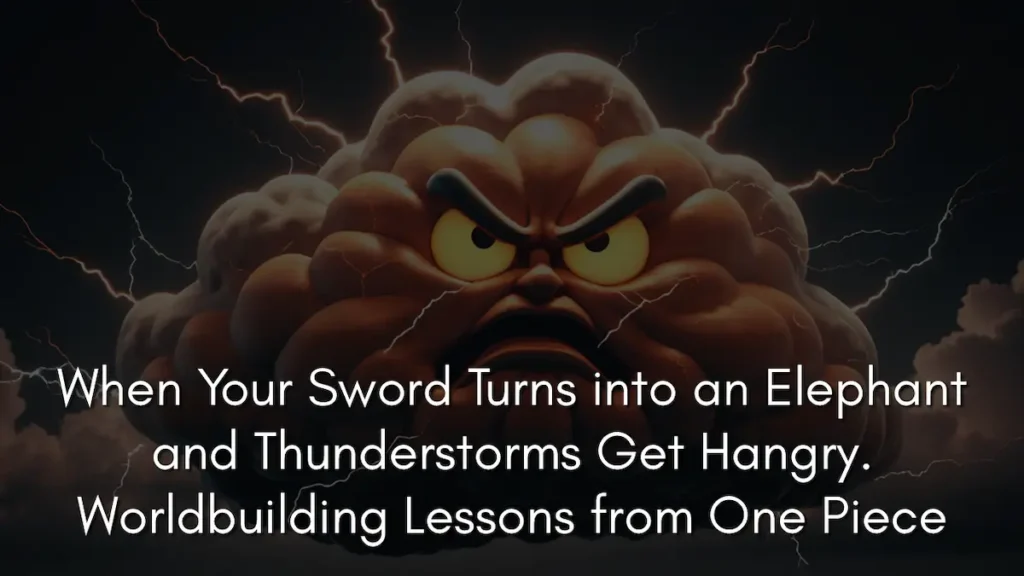
Table of Contents
- When You Feed Your Sword and It Becomes an Elephant with Identity Issues
- Your Bazooka Got Excited and Sneezed Out an Explosive
- Big Mom’s Singing Teapots and Sentient Weather
- Your Ship Loves You Enough to Die Saving You
- Everything Is Alive
- Common Questions About Sentient Objects in One Piece
When You Feed Your Sword and It Becomes an Elephant with Identity Issues
An object that eats a Zoan Devil Fruit does not become enchanted or possessed. It becomes a hybrid organism with an animal’s biology and an object’s original function, existing in an overlap like a Venn diagram that achieved consciousness and immediately regretted it.
The process is deliberate. Dr. Vegapunk invented a method to feed Zoan-type Devil Fruits to inanimate objects, which means the world’s smartest scientist looked at a perfectly functional weapon and decided the correct next step in materials engineering was making it alive.
Only Zoans work. You cannot feed a sword the Bomb-Bomb Fruit. You cannot feed a cannon a Logia. The object eats an animal fruit or the process fails, which means the mad science has limitations but those limitations still permit elephant swords and you have to live in that world now.
Funkfreed was Spandam’s sword before it ate the Zou Zou no Mi and became an elephant that can transform back into a blade. Which gives Spandam a weapon that doubles as transportation, pack animal, and the closest thing he has to a friend willing to tolerate him, assuming elephants can be friends with men who use them as belt accessories.
The elephant is completely real. Funkfreed breathes. Eats. Thinks. Makes independent decisions about when to shift forms and whether Spandam’s current tactical plan is stupid enough to warrant intervention without being asked. The sword did not gain elephant characteristics stapled onto steel. The blade became an elephant that remembers being a sword, and the resulting psychology is what happens when you are a four-ton pachyderm and also a meter of sharpened metal and both states are equally authentic.
The elephant serves Spandam despite Spandam being Spandam, which is either proof of Zoan fruits creating genuine loyalty or proof that even elephants can get trapped in bad employment situations.
Funkfreed has carried Spandam through battles, tolerated being used as a coat rack, and never once gored him for being the kind of person who peaked as a middle manager and expressed that frustration through abusing his direct reports and his sentient sword-elephant.
Your Bazooka Got Excited and Sneezed Out an Explosive
Lassoo started as Mr. 4’s bazooka. Heavy artillery designed to fire explosive baseballs. The weapon required operation by a man with the tactical intelligence of concussed livestock and his partner, a woman who can become a mole, and not in the infiltration sense but in the actually an animal sense. This is already a sign your organization has structural problems.
The gun ate the Inu Inu no Mi, Model: Dachshund. Now the bazooka is a dog. The dog is a bazooka. Lassoo barks, which is normal dog behavior. Lassoo is perpetually sick and coughs out explosive rounds from his mouth-barrel when he sneezes, which is the artillery equivalent of your communication method doubling as lethal ordnance deployment.
The personality is authentically canine. Form shapes function. Lassou displays loyalty to Mr. 4 even though Mr. 4’s primary character trait is being hit in the face with objects.
The dog shows aggression toward enemies.
The dog experiences visible separation anxiety when removed from his owner, complete with whining and attempts to return, because dogs bond with their handlers and the fact that this particular dog is a firearm does not override ten thousand years of domestication instincts breeding true through a weapon.
The method remains restricted. Vegapunk’s process has not proliferated to every blacksmith with a sword and bad judgment. The World Government controls access, preventing the Grand Line from experiencing a Cambrian explosion of carnivorous furniture.
But the technology exists and has been deployed, which means somewhere in a government lab someone looked at a functional blade and said “what if elephant though” and the world’s response was “sure, why not.”
Devil Fruit objects show how consciousness can be installed through weaponized zoology. Feed an object the right fruit and it wakes up as an animal that remembers its previous shape and has to negotiate that identity split every time it transforms.
What cannot be controlled is whether your new elephant-sword likes you, tolerates you out of professional obligation, or is quietly waiting for the right moment to address several workplace grievances using his natural advantages as a multi-ton mammal with a sharp spine.
Big Mom’s Singing Teapots and Sentient Weather
Big Mom does not feed objects Devil Fruits. She conducts live surgery on the fabric of reality using the Soru Soru no Mi, which grants her the ability to physically extract souls from living people and cram them into anything that will hold still long enough to receive the transplant.
Trees. Rocks. Biscuits still cooling on the counter. Clouds. A bicorne hat that transforms into a sword and has called her Mama for decades, which is either proof of deep loyalty or the most elaborate case of Stockholm Syndrome ever expressed through headwear.
The process is simple. Big Mom takes lifespan directly from a human’s body through fear, because Big Mom has never encountered a problem she could not solve by being more frightening than the problem (well, except for Jinbe…). The soul manifests as glowing energy and gets shoved into an object or animal, never a person or corpse. And it becomes sentient.
Homies are objects that received involuntary consciousness installation and now have to exist with that. A teapot gains a face, a voice, the ability to sing, and crippling awareness that it is a teapot and if it chips it might die. Beauty and the Beast, but worse.
Doors open and close and comment on who passes through them. Flowers bloom on command and praise Mama with the enthusiasm of hostages who know the ransom situation is not resolving in their favor.
The personality is not random. Homies absorb fragments from the soul used to animate them, but the donor’s consciousness does not transfer intact. A homie built from your soul will not have your memories, your specific personality, or your crippling insecurity. It will have emotional echoes and behavioral shadows, the kind of degraded copy you get when you photocopy a photocopy until the original’s features show up as vague impressions in lower resolution. (Technically, the original memories are there, just suppressed.)
Most homies operate on shallow emotional range and semi-mandatory loyalty because Big Mom’s power mostly enforces obedience. They sing. They praise Mama. They display zero hesitation about murdering intruders because Big Mom’s soul fragments come pre-installed with her emotional framework, which operates on a binary of violence and cake with no intermediate settings.
Zeus is a thundercloud the size of a commercial building. Prometheus is a miniature sun with a face. Napoleon is the aforementioned bicorne hat that transforms into a longsword on demand.
All three were created using pieces of Big Mom’s own soul, not extracted from victims, which makes them fundamentally different from standard homies the way your biological children are different from your employees, even though both groups might call you Mama under the right circumstances.
They are older. More powerful. More autonomous.
Zeus likes food and electrical storms with equal intensity.
Prometheus likes violence and setting things on fire, which for a miniature sun is less a personality trait and more a job description.
Napoleon serves as tactical advisor, primary weapon, and the nearest thing Big Mom has to an emotional support object, which is a role that requires transforming into a sword on command and occasionally talking her out of destroying her own territory because someone undercooked a croquembouche.
Your Ship Loves You Enough to Die Saving You
Some objects develop consciousness without Devil Fruits or forced soul installation. They accumulate enough sustained human care, enough emotional investment over years of service, that awareness emerges as the natural consequence of prolonged devotion.
This is the Grand Line’s approach to consciousness development through love, which works on the principle that if you cherish something hard enough and long enough, it will eventually cherish you back, and that reciprocal love will manifest as a small spirit who lives in your keel and fixes damage while you sleep.
The Klabautermann is a ship spirit who appears when a ship is cherished and maintained with enough sustained dedication that the vessel develops a protective ghost.
Going Merry was a caravel. Small. Not designed for the Grand Line’s conditions. The Straw Hats pushed that ship past every structural limit and kept it operational through miracles, improvised repairs, and Usopp’s increasingly desperate carpentry as he tried to hold together a hull that was failing at the molecular level. They loved the ship. The ship loved them back.
When Merry was dying from accumulated damage that no amount of repair could reverse, the Klabautermann manifested.
A small child-like figure wearing a raincoat and holding a wooden mallet. The spirit performed emergency repairs during the Skypiea arc, fixing damage the crew could not access while they slept.
Later it appeared directly to Usopp and Iceburg, and explained that the ship could manage a little longer before giving out completely, which is the nautical equivalent of your car developing a ghost who tells you it can get you home but after that it’s finished and you need to let it go.
The Klabautermann spoke. It apologized for not being strong enough to continue. It thanked the crew for caring. Then the ship carried them through Enies Lobby, through a World Government siege, sailed through chaotic currents, and made it to safety before structural failure became total.
The Straw Hats burned Going Merry in a Viking funeral because the ship had been a crewmember and crewmembers get real goodbyes, not scrapyard dismantlement and component recycling.
The ship developed a spirit through sustained affection and that spirit was conscious enough to communicate, make autonomous sacrifices, and choose when to die. Going Merry was a person who happened to be a boat, and that person died protecting their crew because that is what the ship existed to do and love made that purpose absolute.
Other objects harbor similar latent awareness.
The Meito, legendary swords, demonstrate behavioral quirks that read as personality rather than superstition.
Sandai Kitetsu is cursed. The blade has killed every previous wielder. Zoro claimed it anyway through the approved method of throwing it in the air and letting it fall toward his extended arm, betting his luck against the sword’s curse. That luck impressed it enough to accept Zoro as worthy to wield it.
Everything Is Alive
In One Piece, consciousness is cheap. Willpower makes it inevitable. The world runs on conviction, and when you believe in something with enough intensity for long enough, that thing will eventually start believing back.
Feed a gun a dog fruit and the gun becomes a dog that sneezes out explosives because dogs are loyal and guns are weapons and the hybrid expresses both natures with equal authenticity.
Give a cloud a soul fragment and the cloud becomes whatever personality the soul carried, but the cloud will always be a cloud and clouds follow storm systems, so Zeus chases electrical weather and food with equal enthusiasm.
Love a ship past its design lifespan and the ship develops a spirit that prioritizes crew survival above its own existence because ships exist to carry people safely and a ship that loves its crew will beach itself, burn itself, sacrifice itself to complete that purpose one final time before the wood gives out.
Objects develop the exact psychology their form and origin demand.
This creates a world where your relationship with your possessions requires actual ethical consideration because your possessions are running the same calculations about you.
Oda built a world where your gun might be your dog, your hat might be your oldest friend, and your ship might love you enough to become a ghost that patches your hull in the night and then breaks your heart by asking you to let it rest.
[Read more about sentient objects across fantasy in our deep dive.]
Common Questions About Sentient Objects in One Piece
Can any object eat a Devil Fruit to gain sentience in One Piece?
According to the research of Dr. Vegapunk, the process of feeding a fruit to an inanimate object is currently limited to Zoan-type Devil Fruits. This is because Zoan fruits contain the will and biology of an animal, which provides the object with a literal soul and a nervous system. While a sword can become an elephant or a gun can become a dog, the series has not yet shown a way for an object to consume Logia or Paramecia fruits, likely because those powers lack the inherent biological consciousness required to animate a non-living thing.
In One Piece, is a Klabautermann the same thing as a Homie?
No, these two forms of sentience come from completely different sources. A Homie is a forced creation made by Big Mom using the Soru Soru no Mi to physically inject a soul fragment into an object. In contrast, a Klabautermann is a naturally occurring spirit that manifests only when a ship is loved and cared for by its crew over a long period. While Homies are essentially magical servants that can be created instantly, a Klabautermann is a rare, legendary phenomenon born from the emotional bond between sailors and their vessel.
Do objects that eat Devil Fruits in One Piece have their own personalities?
Yes, objects that undergo the Zoan transformation process develop genuine personalities and instincts. These traits are usually a hybrid of the animal’s natural temperament and the object’s original purpose. For example, Lassoo the bazooka displays the loyal but excitable nature of a dachshund, while Funkfreed the sword shows the stoic intelligence of an elephant. These objects are not just tools being controlled by a user. They are living creatures capable of feeling fear, loyalty, and even physical illness.
Why do some cursed swords like Sandai Kitetsu seem to have a mind of their own in One Piece?
In the world of One Piece, high-quality blades known as Meito often possess a distinct temperament that can feel like sentience. A cursed sword does not necessarily contain a Devil Fruit or a soul fragment, but it possesses a bloodthirsty aura that chooses its master. If a swordsman’s willpower is weaker than the blade’s bloodlust, the sword will lead them to their death. This suggests that in this universe, masterful craftsmanship can imbue an object with a spiritual presence that demands respect from its wielder.
What happens to a sentient object in One Piece if its owner dies?
The fate of a sentient object depends on the source of its consciousness. A Klabautermann will usually fade away if the ship is destroyed or if the bond with the crew is broken. Homies created by Big Mom’s power generally remain active as long as the soul fragment inside them remains intact, though they may lose their source of direction. Objects that have eaten Zoan fruits are the most autonomous, as they are essentially animals that happen to have a metal true form, and they likely would continue to exist as independent creatures or wait for a new master to pick them up.
–
Jay Angeline is a science fiction and fantasy writer with a background in physics and over twenty years of analytical work. Through short fiction and worldbuilding articles, Jay explores the mechanics that make imaginary worlds feel real, using a thoughtful lens and a touch of humor.